Vietnam at a glance
First-time visitors to Southeast Asia often start in Vietnam, since one country covers so much ground. Flights land direct or with a single stop in Hanoi or Ho Chi Minh City, keeping journey times sensible, while hotels and restaurants cost noticeably less than in many neighbouring destinations. Stay inside Vietnam and your itinerary can still run from temple visits and museums to a night cruising a UNESCO-listed bay, a few days trekking among hill villages, and time on the sand.
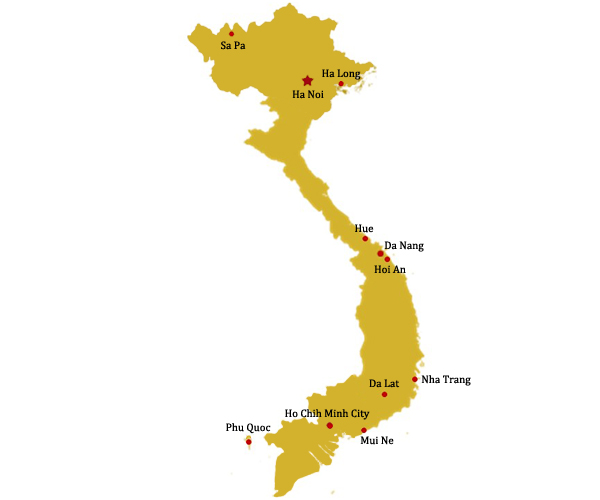
Because the country runs almost 1,650 km top to bottom, there's no such thing as a single 'Vietnam forecast' — only regional weather. Sa Pa, Ha Long and Hanoi sit in the humid north, where heat builds from May through October, drier and cooler conditions take hold from November until April, and December and January can turn properly cold, particularly in the far north around Sa Pa. Head south to the centre — Da Nang, Hue, Hoi An, Nha Trang, Da Lat — and the pattern flips: dry heat holds from January to August before rain builds across September, October and November. Further south again, around Ho Chi Minh City, Mui Ne and Phu Quoc, skies stay dry from November through April, then turn humid and wet for the May-to-October stretch, when the heaviest downpours land in June, July and August. Planning a trip across all three zones? Book between October and April for the best odds of dry weather throughout.
Match the region to the trip: couples often pair Ha Long Bay with Da Lat, beach-seekers head to Nha Trang or Phu Quoc, and trekkers make for the hill tribes around Sa Pa. The capital, Hanoi, is where most northern itineraries begin. Money runs on the Vietnamese Dong (VND), and first-timers are often thrown by how many zeros the notes carry — the smallest note in common circulation is 1,000 VND. Vietnamese is spoken everywhere day to day, though guides and hotel staff generally handle English in the places tourists visit rather than nationwide.
Where to go
Practical information
| Details | |
|---|---|
| Best time to travel | October to April overall; north is cool/dry Nov-Apr, centre is drier Jan-Aug, south is dry Nov-Apr |
| Currency | Vietnamese Dong (VND) — smallest common note is 1,000 VND |
| Language | Vietnamese; English spoken in tourist areas |
| Main gateways | Hanoi (Noi Bai), Ho Chi Minh City (Tan Son Nhat), Da Nang International Airport |
Planning your trip
Trip length varies enormously: a short four-day break based in Hanoi sits at one end, a full 25-day route covering Sa Pa, Ha Long Bay, Hanoi, Hue, Da Nang and further destinations at the other. Most people land somewhere in the middle, booking six to ten nights and covering two or three regions of the country. When travellers ask to upgrade an itinerary, it's usually to add either a night aboard a Ha Long Bay cruise or a highlands extension linking Hanoi with Sa Pa.
A beach extension to Phu Quoc, Nha Trang or Mui Ne, or a slower, honeymoon-paced stop in Da Lat, can be built onto any of these. Tell us your dates, the places you want to combine and how many are travelling, and we will put together a day-by-day plan with hotel options — no price is fixed until we confirm the details with you by email.
How your trip is run
Our Vietnam trips are run through a team based in Hanoi, so hotel confirmations, guide bookings and any changes needed mid-trip are handled locally rather than passed along a chain. That means quicker answers while you're planning, and a direct point of contact if anything needs adjusting once you're already on the road.