Cambodia, the short version
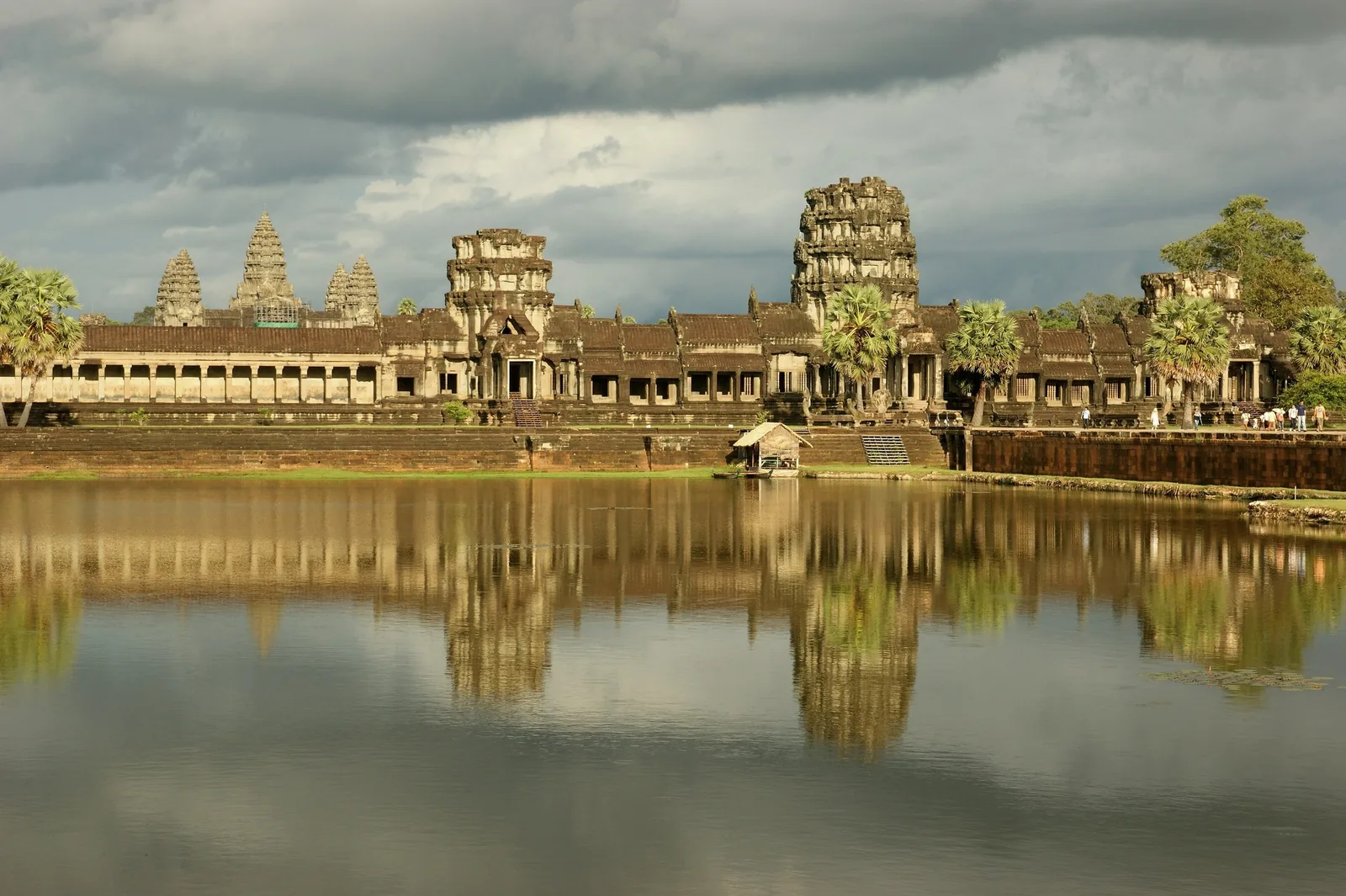
Cambodia is small enough to see properly in a week and rewards travelling slowly. Our guides are Khmer, most of them from Siem Reap province, and they take the temples in an order that avoids the tour-bus rhythm — Angkor Wat at sunrise, yes, but Bayon after four when the light is low and the coaches have left.
Cambodia is one of the most straightforward countries to picture before you book: the temples of Angkor Wat and the wider Angkor complex near Siem Reap, combined with a stay in the riverside capital, Phnom Penh. That focus makes it a natural standalone trip of three to five nights, and an easy extension onto a Vietnam itinerary, since the two countries share a border with short flight and overland connections between them.
Neighbours ring Cambodia on every landward side — Vietnam runs along its eastern and southern edge, Laos lies northeast, and Thailand stretches across the west and northwest — while the Gulf of Thailand forms the southwestern coastline, placing the country in the far southeast of the Indochina Peninsula. Expect warm, tropical weather in every month: the south-west monsoon delivers rain between May and mid-November, and skies turn dry from mid-November through to April. Given Cambodia's small size, that seasonal pattern barely shifts between Siem Reap and Phnom Penh, making the November-through-April stretch the dependable choice for most itineraries.
Two kinds of traveller tend to choose Cambodia: those new to Southeast Asia looking for a heritage-focused trip that doesn't demand weeks away, and those already building a Vietnam itinerary who want to fold in a second country. Phnom Penh serves as the capital. Officially the currency is the Cambodian Riel (KHR), though nearly every transaction can be made in US dollars, which circulate freely alongside it. Khmer is spoken nationwide, with pockets of Vietnamese and Thai near the respective borders.
Where we go in Cambodia
Rather than visiting just one city, most travellers combine Phnom Penh with Siem Reap — the two are simple to connect, and together they deliver both the capital's sights and the temples on a single trip.
The practical bits
| Details | |
|---|---|
| When to come | Mid-November to April is dry; May to October is wet but green, with fewer visitors |
| Money | Cambodian Riel for small purchases; US dollars accepted almost everywhere |
| Language | Khmer; English in hotels, with guides and in Siem Reap's restaurants |
| Flying in | Phnom Penh and Siem Reap Angkor international airports; overland from Vietnam and Thailand too |
Shaping your Cambodia trip
Trips here range from a three-night Siem Reap temple visit on its own to a six-night Phnom Penh and Siem Reap combination, with four and five nights the most popular length for that same pairing. Every itinerary is timed around an Angkor Wat sunrise or sunset, since that is what most travellers ask for first.
An extension into Vietnam, most often Ho Chi Minh City, is easy to add given how short the connection is between the two countries. Tell us your dates and how much time you would rather spend at the temples versus the capital, and we will send back a day-by-day plan by email, with a quote to follow.
Who looks after you in Cambodia
A Phnom Penh-based team handles every Cambodia trip we run, which means hotel bookings, temple-pass arrangements and guide schedules in Siem Reap and Phnom Penh are managed on the ground rather than from afar. When your plans change close to departure, that on-the-ground presence is what lets us confirm changes quickly.