About this trip
Most people who visit Laos see one city and stop there, which sells the country short — it has hill scenery, a gentler pace than the countries around it, and heritage recognised by UNESCO. Over thirteen days, this route sets out to show you the whole country, not just a single stop: temples in Luang Prabang, the stone jars scattered at Xieng Khuang, the monuments of Vientiane, limestone caves near Ban Na Hin, and Si Phan Don, the little-visited '4000 Islands' close to Cambodia.
The pace stays unhurried, with two or more nights at most stops and only a few longer drives between them. It suits travellers who have already seen the region's better-known cities and want a different kind of Mekong trip — river time, cave exploration by canoe, coffee country on the Bolaven Plateau — over a beach or shopping-led one. Aim for November to February for the coolest, driest conditions at the caves and waterfalls along this route.
Trip highlights
- Three nights based in Luang Prabang, covering the town's temples, the Pak Ou Caves and Kuang Si Falls
- The Plain of Jars archaeological site at Xieng Khuang
- A half-day tour of Vientiane taking in That Luang, Haw Phra Kaew and Wat Sisaket
- Boat trip through Khong Lor Cave's 7.5km limestone tunnel
- Wat Phu, a UNESCO World Heritage pre-Angkorian temple near Champasak
- Khone Phapheng Falls, the '4000 Islands' of Si Phan Don and, conditions permitting, sightings of Irrawaddy dolphins
Day by day
Day 1: Arrival in Luang Prabang
Your trip opens in Luang Prabang, at the confluence where the Nam Khan flows into the Mekong. UNESCO protects the town for its blend of French colonial buildings and traditional wooden Lao houses, and the atmosphere — gilded temples, monks in saffron robes, an unhurried riverside feel — sets the tone for the days ahead. Nothing is planned for today, giving you time to settle in and explore at whatever pace you like.
Day 2: Luang Prabang city tour and Kuang Si Falls
You can walk the whole of Luang Prabang's old quarter today, passing the former Royal Palace, Wat Xieng Thong and other gilded temples on the way, along with the town's morning market. A short drive out brings you to Kuang Si Falls, where forested, tiered pools of turquoise water are open for swimming, plus a handful of marked walking trails for those who'd rather stay dry.
Day 3: Pak Ou Caves
The Pak Ou Caves hold thousands of Buddha images, left there across generations by visiting pilgrims. Cut into a cliff of limestone at the spot where the Nam Ou joins the wider Mekong, they're reached by a boat trip past forested banks and riverside villages — a journey as memorable as the caves themselves.
Day 4: Luang Prabang to Xieng Khuang
From Luang Prabang the route continues to Xieng Khuang province and the Plain of Jars, where huge stone jars are strewn across open grassland — one of Southeast Asia's more puzzling archaeological sites. Sitting on a cool upland plateau, the province also carries a hard history of wartime bombing, laid out clearly in local exhibitions.
Day 5: Xieng Khuang to Vang Vieng, city tour
Vang Vieng sits beside the Nam Song, ringed by dramatic karst peaks, and has become Laos's outdoor-activity centre — caves to explore, rivers to kayak, country lanes to cycle. Its centre stays small and easy to walk, with restaurants overlooking the water and a pace slower than either Vientiane or Luang Prabang.
Day 6: Vang Vieng to Vientiane, half-day city tour
Vientiane's leading sites fill a half-day itinerary once you arrive. That Luang, regarded as the nation's most significant symbol, is a gilded stupa; the Patuxay Monument recalls Paris's Arc de Triomphe; Haw Phra Kaew once served as a royal temple and briefly housed the Emerald Buddha; and Wat Sisaket, the capital's oldest temple, lines its cloister walls with thousands of Buddha figures.
Day 7: Vientiane to Ban Na Hin via Tha Khaek
South of Vientiane the road passes Tha Khaek, once a French administrative post on the Mekong, on its way to Ban Na Hin, where the Khong Lor cave network begins. Fewer visitors reach this limestone-karst stretch of central Laos, and its mood is rural and unhurried.
Day 8: Khong Lor Cave
Khong Lor Cave is a short drive from here, carved by the Hinboun River across a 7.5km stretch through the mountain. You travel through it by motorised canoe, beneath ceilings that reach 100 metres and past dramatic limestone formations, with two waterfalls breaking up the return trip.
Day 9: Ban Na Hin to Pakse via Savannakhet
Through Savannakhet province the road continues south to Pakse, the main hub of southern Laos and long a trading link between the country, Thailand and Vietnam. Expect a full day of driving, with an own-expense lunch stop en route, before checking into your Pakse hotel for the night.
Day 10: Pakse to Don Khong via Wat Phu (Champasak)
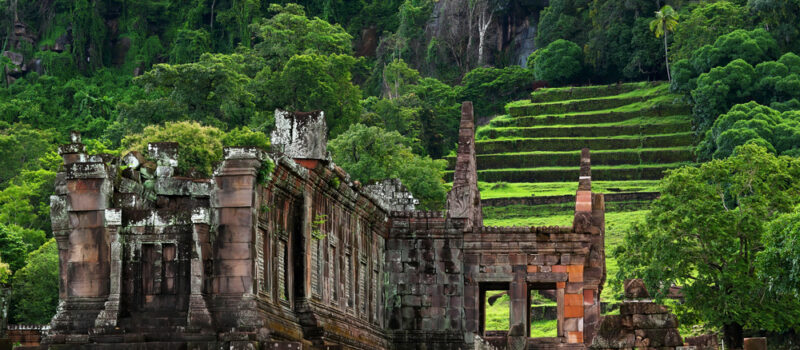
Champasak is next, reached from Pakse, and its main draw is Wat Phu — a Khmer temple complex older than Cambodia's Angkor, standing at the base of Phu Kao's slopes and holding UNESCO World Heritage status. Built around the tenth century, it's counted among Laos's best-kept Khmer religious sites. You then push on to spend the night on Don Khong island.
Day 11: Don Khong and the 4000 Islands
Si Phan Don takes the whole day: this is the stretch, near the border with Cambodia, where the Mekong widens into the so-called '4000 Islands'. Ban Khone holds colonial-era buildings and the country's one surviving railway locomotive, and a tuk-tuk ride carries you onward to the Liphi waterfall, known locally as Somphamit. The day also brings Khone Phapheng Falls — reckoned Southeast Asia's biggest waterfall by volume — and, season and weather allowing, a chance of glimpsing rare Irrawaddy dolphins.
Day 12: Don Khong to Pakse via Tadlo and the Bolaven Plateau
Heading back to Pakse, the road climbs onto the Bolaven Plateau, a good deal cooler than the valley the Mekong runs through, and known for coffee, tea and cardamom grown here. On the way to Tadlo, the plateau's higher rainfall feeds a run of waterfalls along the drive, offering one final view of rural, southern Laos ahead of the night back in Pakse.
Day 13: Departure
A transfer from here brings you to Pakse International Airport, in time for your flight onward or back home — the finish of a journey spanning the whole length of the country, starting at Luang Prabang's temples in the north and closing at the far south's 4000 Islands.
What's included
- English-speaking tour guides
- Land transportation by air-con vehicles
- Accommodation based on Twin-shared room with breakfast
- Meals as mentioned in the program (no drinks)
- Boat trips and admissions as mentioned in the program
- Drinking water during the touring day (2 bottles/person/day)
Not included
- Airfare (international and domestic) and airport tax ( on request )
- Visa services (Visa approval letter/Visa stamp fee/ Visa fast track on request)
- Early check-in/late check-out/ room upgrade surcharge
- Other meals, Drinks, and personal expenses (phone call, laundry, tipping etc.)
- Any services not mentioned in the program
- Optional Tours
Book this trip
- Days
- 12 nights / 13 days
Sending this does not charge you. We hold the space and confirm within 24 hours.
Our [travel information for Laos](laos/travel-information) page covers visa rules, payment terms and cancellation policy for this trip.
Tell us your preferred dates and how many are travelling, and we'll come back to you with a tailored quote. Nothing is booked until you confirm.